
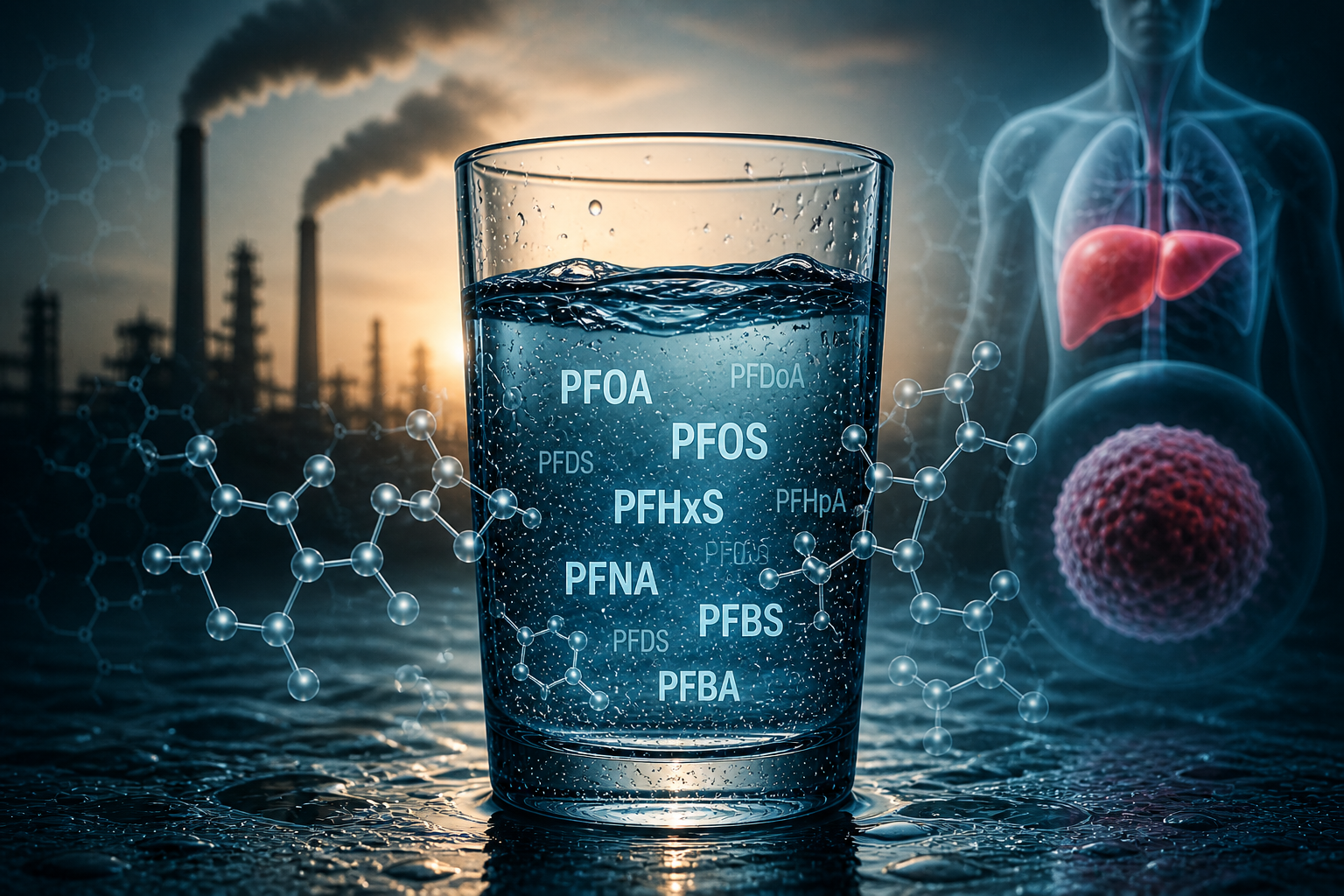
PFAS in Drinking Water: We Have a Problem – And It’s Bigger Than Many Think
Why new studies on liver damage and cancer risks are fundamentally changing the debate!
PFAS are not a buzzword, not a passing headline, and not a theoretical environmental topic anymore. PFAS represent a structural challenge for our drinking water—globally. And that is precisely why they require a clear, understandable, and technically grounded perspective. Not to create fear, but to acknowledge reality and draw the necessary conclusions.
PFAS—per- and polyfluoroalkyl substances—are synthetic chemicals engineered for extreme performance. They are heat-resistant, water- and grease-repellent, and exceptionally durable. What is considered a technical advantage in industry becomes a systemic problem in the context of drinking water.
The reason lies in their chemistry. The carbon–fluorine bond is one of the strongest known in organic chemistry. PFAS do not meaningfully degrade in the environment. They move through the water cycle, accumulate, and persist in the human body over long periods of time. The term “forever chemicals” is not an exaggeration—it is an accurate description.
The health dimension is no longer hypothetical—it is scientifically substantiated. Numerous studies have linked PFAS exposure to hormonal disruption, reduced fertility, immune system effects, and an increased risk of cancer. Recent research goes further: certain PFAS have been associated with liver toxicity and show clear indications of carcinogenic potential under long-term exposure.¹ ²
The discussion is therefore no longer about whether PFAS are problematic, but about the magnitude and long-term implications of their impact on the human body. What matters is not a single exposure event, but continuous intake over years—especially through drinking water.
PFAS do not enter water by accident. They are the result of decades of industrial use and a global distribution of substances that cannot simply be reversed. Once in groundwater, they are highly mobile, extremely difficult to remove, and capable of contaminating water resources for generations. Measurements show that PFAS are no longer a local issue. They are detectable almost everywhere—even in regions where “pristine purity” would be expected, including the Arctic and Antarctic.
Against this background, the discussion of regulatory limits can be misleading. Limits are not proof of safety—they are tools of damage control. The tightening of European thresholds is not symbolic; it is a direct consequence of the available data.
Responsibility therefore begins long before treatment—it begins with prevention.
Drinking water is not a single parameter or an isolated measurement. It is a system. It is influenced by treatment processes, transport, storage, and—critically—the materials and components used throughout the system. PFAS illustrate how sensitive this system is. Every unnecessary material complexity and every unclear source increases the risk of contamination—directly or indirectly.
This is why it is insufficient to discuss water quality without addressing material choices. Anyone who takes drinking water seriously must adopt a clear position: conscious material selection, full transparency, and the consistent reduction of potential sources of contamination.
PFAS are not an anomaly. They are the outcome of a system that prioritized technical performance over long-term responsibility.
In the end, the conclusion is clear: drinking water is not just another medium. It is the most sensitive food we have. And that is exactly why it requires no reassurance, but clear decisions, sound engineering, and uncompromising standards.
Knowledge is the first step. Consistency is the second.
¹ ScienceDirect, Environmental Research (2025): PFAS exposure and liver toxicity / carcinogenic pathways
https://www.sciencedirect.com/science/article/pii/S0160412025005148
² ATSDR / CDC (Agency for Toxic Substances and Disease Registry): Toxicological Profile for Perfluoroalkyls
https://www.atsdr.cdc.gov/pfas/index.html