
Article: Stop Replacing Parts. Start Solving Technical Problems.
Stop Replacing Parts. Start Solving Technical Problems.
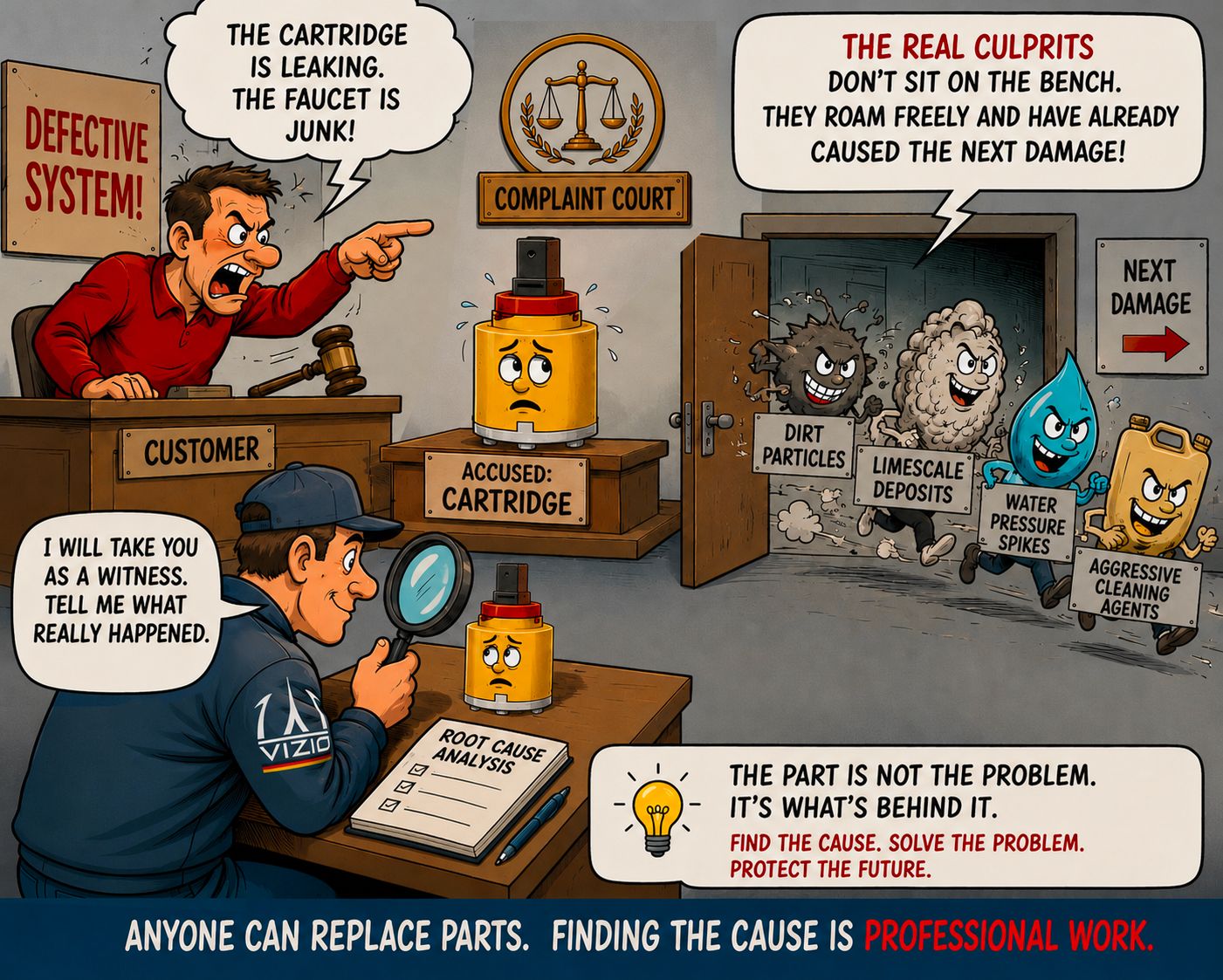
 “The cartridge is leaking. The faucet is defective.”
The component is immediately treated as the guilty party.
But the real culprit - dirt particles, limescale buildup, water hammer, or aggressive cleaning chemicals - isn't sitting in the dock at all. It's still out there, quietly causing the next failure.
This is where many technical warranty claims go wrong from the very beginning.
The focus is placed on the component that failed.
Our focus is on a completely different question:
Why did this component fail in the first place?
That is far more than a subtle distinction.
It is the difference between simply replacing a part and performing a proper technical analysis.
Components Don't Fail Without a Reason
In engineering, one principle applies almost universally:
Nothing fails without a reason.
Every failure has a cause.
And this is exactly why a damaged component is often not the real problem, but merely the first visible evidence that something else has already gone wrong.
A failed component does not automatically prove that it was defective.
It only proves that something happened.
The Thermometer Analogy
Imagine visiting your doctor with a fever.
Instead of looking for the infection, the doctor simply replaces the thermometer.
Absurd, isn't it?
The thermometer didn't cause the fever.
It merely revealed that there was already a problem inside the body.
Technical failures work exactly the same way.
A leaking cartridge does not begin leaking without a reason.
A surface coating does not peel off spontaneously.
A sensor does not report an error without an underlying cause.
The component is simply showing that somewhere in the system there is a cause that must be identified.
Only by eliminating the root cause can you prevent the same failure from happening again.
Common Root Causes of Technical Failures
The underlying cause may include:
- Dirt particles and debris
- Limescale deposits
- Water hammer and pressure surges
- Aggressive cleaning chemicals
- Poor water quality
- Chemical reactions or contamination
- Excessive moisture or humidity
Replacing the damaged part may restore functionality.
Root cause analysis prevents the same failure from returning.
That is the critical difference.
Replacing Parts Doesn't Always Solve the Problem
If you only replace the damaged component, you may fix the symptom - but not the underlying issue.
In many cases, the problem simply reappears during the next warranty claim, service call, or customer complaint.
This is precisely why we sometimes ask more questions than customers expect.
Not because we want to reject warranty claims.
Not because we enjoy discussions.
But because we want to help ensure that you don't experience the same failure again just weeks or months later.
We Don't Just Replace Parts - We Solve Technical Problems
A lasting solution requires more than finding someone to blame.
It requires understanding why the failure occurred and permanently eliminating its cause.
That process can only succeed through cooperation between manufacturer and customer.
Because sustainable engineering is not about replacing components.
It's about solving the real problem!